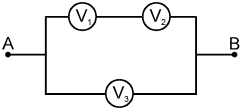
Three voltmeters, all having different resistances, are joined as shown. When some potential difference is applied across A and B, their readings are V 1 , V 2 , V 3 :
Text Solution
Verified by ExpertsThe correct answer is:
CHECK THE SOLUTION.
(b, c)
In parallel combination potential difference are same
So, V 1 + V 2 = V 3
Here V 1 and V 2 are in series but their resistances are different
V 2 = iR 2
V 1 ≠ V 2
Prepare Smarter with CGP Edu
Get practice questions, solutions, and test series in one place.
Write a Review
Share your experience with this question and solution.
Commentary
Send your comment, doubt, correction, or feedback to admin.
Similar Questions
Explore conceptually related problems
The balancing length for a cell is 560 cm in a potentiometer experiment. When an external resistanc…
The series combination of two batteries, both of the same emf 10V, but different internal resistanc…
Four resistances of 15 Ω Ω , 12 Ω Ω , 4 Ω Ω and 10 Ω Ω respectively in cyclic order to form Wheatst…
Match the following:
The following table gives the lengths of four copper rods at the same temperat…
Match the statements in Column I with the current element in Column II
Column - IColumn - II(A)Curr…
A continuous beam of electrons emitted by a heating filament are accelerated in free space by an el…